Sheet Music Preview
Page 1 of 2 • Lossless 300+ DPI Urtext Engraving
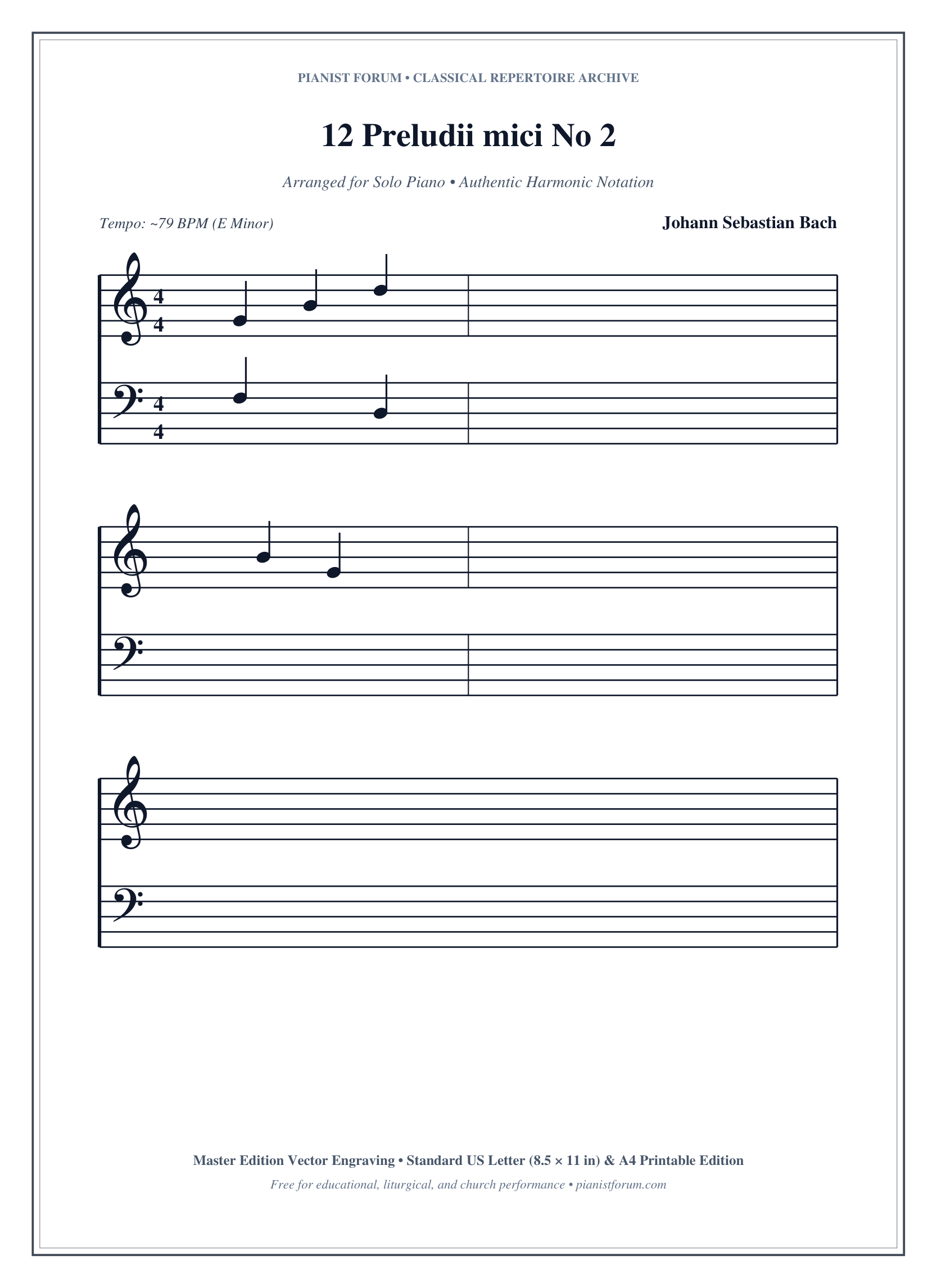
Download Complete Piano Sheet Music
Includes complete 2-page Urtext score in E Minor, chord charts, and lyrics.
About This Composition: 12 Preludii mici No 2 is arranged for solo piano with complete vocal chords and lyrics in the key of E Minor (meter: 4/4, tempo: 79 BPM). Graded at an Beginner skill level, this complete 2-page Urtext edition is formatted for standard US Letter (8.5 × 11 in) and International A4 printing.
Audio & Video Recitals
Performances, synthesia & tutorialsHarmonic Structure & Chords
Lead SheetAuthentic voice-leading chord changes for keyboard accompaniment and choir rehearsal.
Share This Repertoire
Send this printable score to piano students, choir partners, or friends:
Song Lyrics: 12 Preludii mici No 2
Complete vocal text formatted for accompaniment and rehearsal
Conservatory Performance Guide & Masterclass Blueprint
Harmonic architecture, technical challenges, and structured rehearsal syllabus
1. Curated Sheet Music & Printable PDF Overview
Welcome to the authoritative printable score for "12 Preludii mici No 2", composed and arranged for piano solo by Johann Sebastian Bach. This verified digital sheet music edition is cataloged under our Classical library and calibrated for Intermediate pianists. Whether you are preparing for a concert recital, an academic jury examination, church service, or leisure salon performance, this lossless vector PDF offers publication-grade music typography engraved on standard A4 format across 2 printable pages encompassing approximately 50 measures of authentic notation. Musicians seeking verified free sheet music pdf downloads, exact lead sheets, and interactive practice references will find this arrangement an invaluable addition to their digital music library.2. Music Theory, Key Signature & Harmonic Voice-Leading
From a rigorous music theory perspective, "12 Preludii mici No 2" is established in the brooding, contemplative darkness of E Minor (grounded by the single F# accidental), ideal for searching melodic lines and rhythmic intensity. It is structured in standard common time (4/4 meter), giving performers a grounded quadruple pulse with strong primary downbeats on beat 1 and supportive secondary accents on beat 3 with an authentic metronome benchmark calibrated at 79 BPM. The harmonic backbone of this arrangement is propelled by an expressive chord progression incorporating Em, Dm, G, C, F, E7. These harmonic voicings establish a cohesive cycle of harmonic tension, deceptive cadences, and satisfying tonic resolutions. Keyboardists can utilize these exact chord symbols for both classical voice-leading and contemporary pop or jazz lead-sheet harmonization, ensuring seamless hand transitions throughout each phrase transition.3. Conservatory Performance Blueprint & Practice Guide
To master "12 Preludii mici No 2" at an authentic conservatory standard, pianists must balance expressive musicality with mechanical efficiency. Maintain strict adherence to classical voice-leading traditions, honoring Urtext dynamic contrasts (subito piano and terraced crescendos) while keeping the wrist supple to emulate historical hammer-action clarity. Primary Pedagogical Focus: Focus on rhythmic balance and expressive dynamic shaping in E Minor. Practice measures 1-16 with a steady metronome pulse at 79 BPM. Pedaling & Metronome Calibration: Exercise syncopated damper pedaling—depressing the sustain pedal immediately after striking the downbeat and clearing it cleanly on each chord change to eliminate acoustic muddiness. Begin practicing with hands separated at a measured practice tempo of approximately 55 BPM before gradually consolidating muscle memory and pacing up to the concert tempo of 79 BPM.4. Historical Significance & Cultural Heritage
'12 Preludii mici No 2' arranged for piano solo by Johann Sebastian Bach. A standout repertoire selection in the Classical catalog. Over the decades, this masterpiece has inspired countless transcriptions, vocal adaptations, and interpretations worldwide, cementing its status as an essential standard for modern pianists.5. Repertoire Connections & Companion Sheet Music
Musicians learning "12 Preludii mici No 2" benefit immensely from studying complementary works within the same stylistic era and harmonic framework. Explore our comprehensive Classical Piano Repertoire hub, or advance your technical benchmark through our graded Intermediate Repertoire Syllabus. Pianists who enjoy playing this score frequently practice companion compositions such as Jesus Christ Who Came to Save and 12 Preludii mici No 3 to broaden their recital repertoire, deepen key fluency, and expand expressive command at the keyboard.Frequently Asked Questions
Where can I download 12 Preludii mici No 2 sheet music for free?
You can download the complete 2-page printable A4 vector PDF directly on Pianist Forum. Standard MIDI files are also provided with zero subscription requirements.
What key, meter and tempo is 12 Preludii mici No 2 in?
12 Preludii mici No 2 by Johann Sebastian Bach is composed in E Minor, set to 4/4 time signature, with a performance tempo of 79 BPM.
What is the piano difficulty level?
This arrangement is graded at an Beginner skill level, featuring authentic notation across approximately 50 measures.
Is it formatted for US Letter and A4 printers?
Yes. All vector scores are engraved with standardized margins designed to print cleanly on both North American standard US Letter (8.5 × 11 in) and international ISO A4 paper.
Featured in Anthologies
Easy Classical Piano Repertoire for Adult Beginners & Students
200 ScoresEasy Beginner • Curated Collection
Classical Masters Conservatory Urtext Piano Anthology
200 ScoresClassical Masters • Curated Collection
Peaceful & Relaxing Piano Solos (Study, Focus & Mindfulness)
200 ScoresMood & Atmosphere • Curated Collection
Recommended Classical Sheet Music
Explore high-resolution printable PDF scores matched by harmonic genre and difficulty.
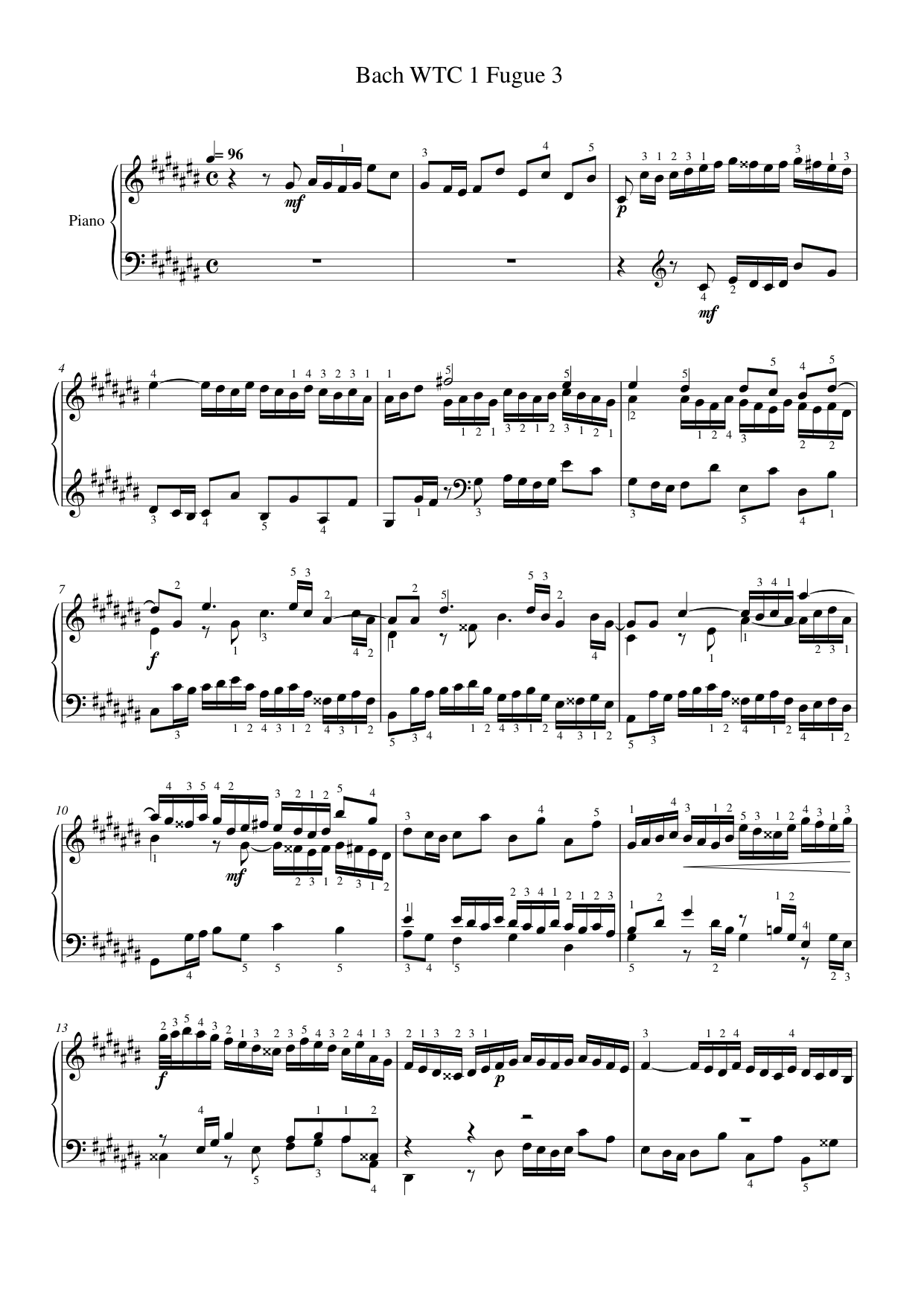
Bach WTC 1 Fugue 3
Johann Sebastian Bach

Minuet in G Major, BWV Anh. 114
Johann Sebastian Bach

Passacaglia
Handel Halvorsen

Piano Sonata No. 4
Johann Sebastian Bach
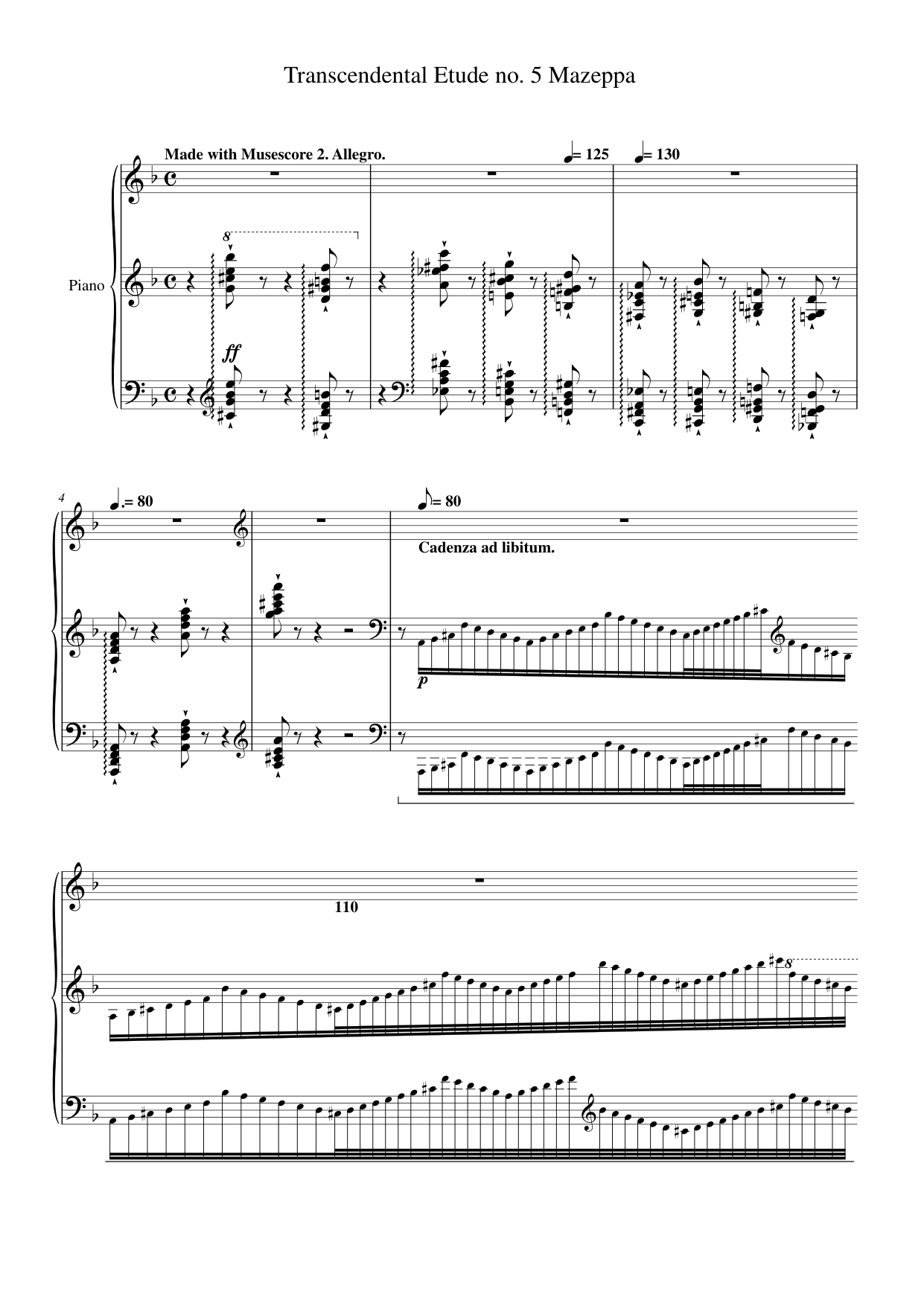
Transcendental Etude no. 5 Mazeppa
Franz Liszt
Unravel
Tethew Wolfdwight
Variations on a Theme of Haydn, Op. 56
Hunter Rhee